
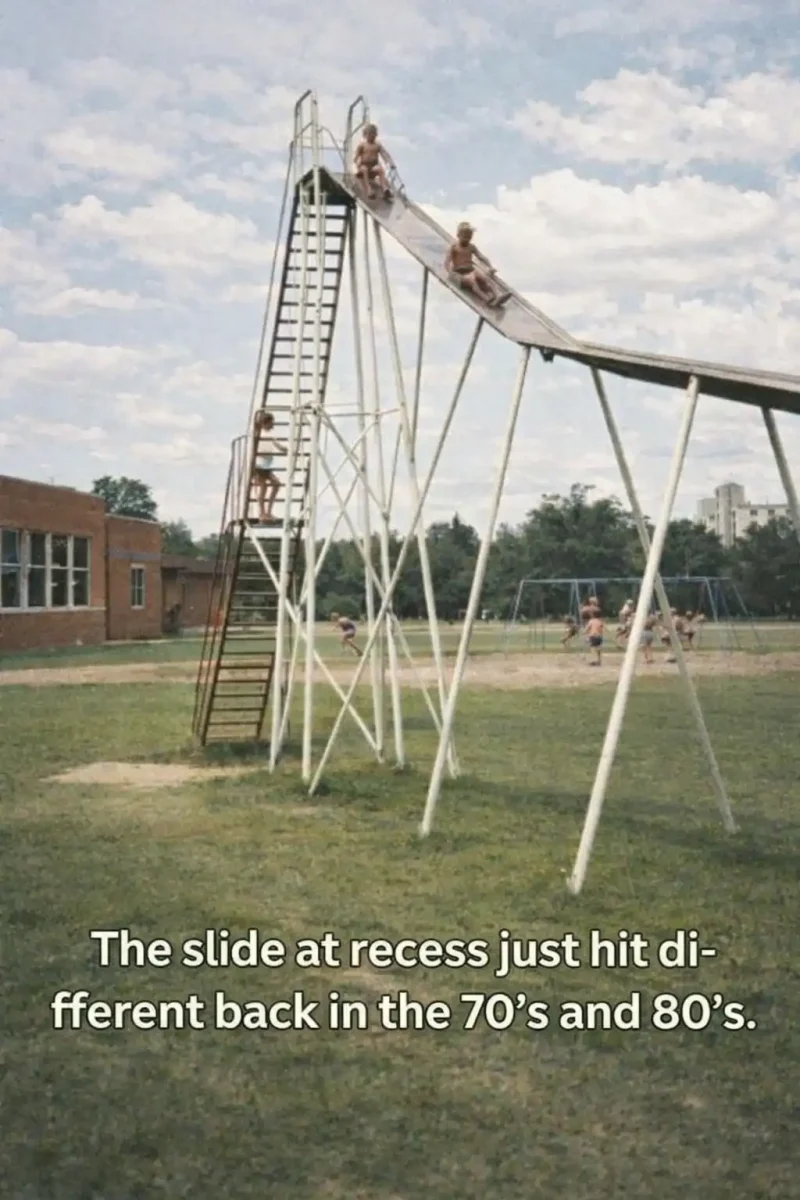
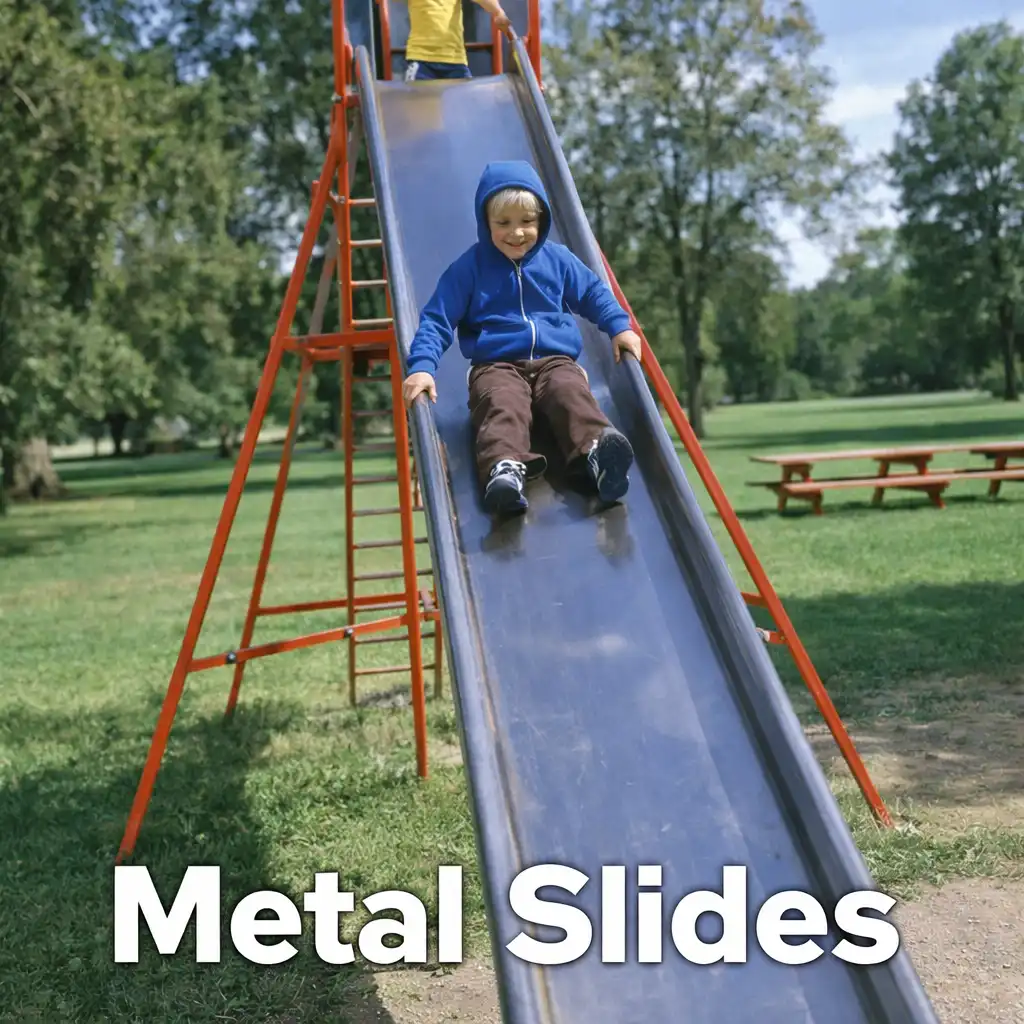
Do you remember the Metal Slide that stood in the center of the park like a giant silver thing? It was huge. 12 feet high, made of galvanized steel.

Most importantly, in the middle of July, it was basically a skillet.
Today, kids have the colorful, twisted plastic tube, but we had the metal slide.
If you grew up before 1980, you know what I’m talking about. You should have climbed the ricky ladder, looked down at the harsh ground below.
Then you took the position. That’s when you realize how hard your butt got kicked. Funny right!
The metal slide heated up due to summer sun for 6 straight hours. But you never climed back down. That was social suicide.
So, you did the only thing you could which was you puched yourself.
This scorched the backs of your bare legs all the way down. Plus, you prayed your rubber sneakers wouldn’t catch the edge and send you tumbling. What a tactic.
So, let’s join with me to here the story of the Metal Slide the king of the playground. It taught us valuable lessons about thermodynamics.
The “Skillet” Effect (The Heat)
Back then we didn’t use a thermometer to know how hot outside. We simply just touched the metal slide. I meant when we were kids.
The physics used for it was simple but brutal. There were two massive sheets of condctive metal angled directly at sun.
As I remember, on a standard 85-degree day, the surface of metal slide easily exceed 140 degree. Brutal right?
Think like this temperature limit is hot enough to boil an egg. And we brave people (lol) placed our butts onto it wearing nothing but flimsy cotton shorts. Crazy right?
The worst part of this play was not the burn, it was the friction. Metal was super hot and your skin basically stick to the surface.
Becasue of that stickiness, you didn’t slide smoothly through the slide. You just squeaked and stuttered your way down.
This peeled your thighs off the metal inch by painful inch. How terrifing.
Basically it was a brun and brake at the same time. Imgine the pain we felt. Still we enjoyed it.
You reached the bottom with red, tender stripes on the back of your legs. Then, you waited for 5 minutes and did it again. Lol.

Towering Giants (The Height)
Now you think, it was totally ok to use a metal slide when the sun went down. No its not. The next challenge for us was the altitude.
Modern slides don’t use slides that rise more than 5 or 6 feet off the ground. They are safe, gentle, and eclosed.
But the slides of the 1960s and 70s were basically skyscrapers.
Many metal slides stood 10 to 12 feet high. Terrifying right!
That is like when you are a 7-year-old standing at the top, you are practically in the stratosphere.
Climbing up was also a challenge. Ladders were steep, and the vertical climbs with thin metal rungs and wide gaps made it scarier. Even a little child could easily slip through the gap.
There were basically no enclosed tunnels like modern slides.
Once you reach the top, you need to sit on a small metal seat. It had nothing but a flimsy handrail between you and the scary drop.
Actually, you weren’t sliding down, you were committing. The angle was super steep. Sometimes 45 degrees.
You basically picked up the speed before you hit the ground like a ball.
The “Wax Paper” Trick (Need for Speed)
Sometimes old metal slides were rusty and sticky. This slowed you down to a boring crawl.
But there was always that one person in our neighborhood who knew how to break the sound barrier.
That was the wax paper.
Wax paper is like a small hack. We sneaked a roll of Mom’s Cut-Rite wax paper (or sometimes an empty bread bag) out of the kitchen and brought it to the park to use this trick.
You basically sat on the sheet. Then, lift your feet and let go. Simple as that!
The wax-coated tehe warm metal. This eliminated all the friction. Now you weren’t sliding, you were launching like a rocket.
Speed was super fast and terrifying. You basically could catch air over the bumps like you were riding a motorbike.
When you hit the ground at high speed, you should land on your feet. Otherwise, your butt gets hurt.
I remember I was shooting off the end of the slide like a human cannonball. I threw 5 feet away in the dirt.
Yes, it was dangerous, reckless, and the most fun you could get for pennies. What an experience!
The Landing Zone (Asphalt & Gravel)
Nowadays, playgrounds are bouncy. It is covered in thick rubber mats or a soft cushion.
Luckily, we didn’t like the luxury. We wanted the real experience.
We had the Landing Zone of Death.
City planners in the 1970s decided to put an asphalt surface at the bottom of a 12-foot metal slide. Funny right!
Sometimes you got jagged gravel or packed dirt that felt like concrete. Lol.
When you’re coming off a hot slide with high speed meat hitting the hard ground with a bone-jarring thud. Terrifying right!
If you haven’t used the wax paper trick as I described above, you might end up with scraped knees, elbows, and chin against the pavement.
There were no doctors on standby. We just dusted off the gavel embedded in our knees, checked for major leaks and again climbed up the ladder like a champ.
Playgrounds of those days were designed for stuntmen. They were high, hot, and harsh.
Most importantly, those playgrounds gave us experience and taught us about resilience. We learned by climbing too high, we might fall with damage.
We learned that metal gets hot quickly, and we learned how to get up quickly when we hit the dirt.
We didn’t need bubble wrap. We just needed a little bit of Mercurochrome, and we were back with full energy.
Let us know your experience with metal slides in the 70s in the comments section. I’d love to know!